
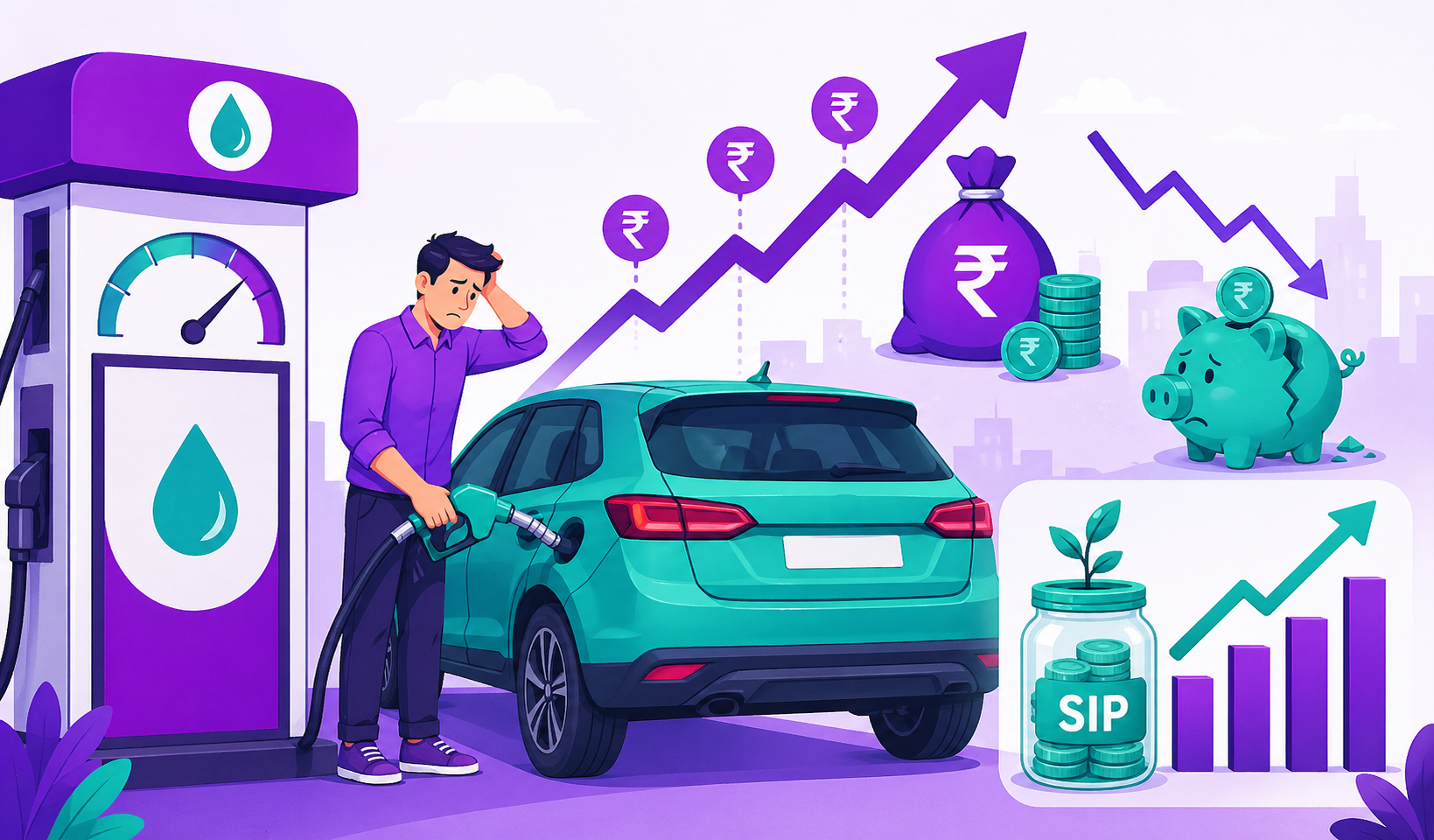
The Price at the Pump Is Only Part of the Problem
April 25, 2026. Petrol is Rs.94.77 per litre in Delhi. Rs.103.54 in Mumbai. Rs.107.46 in Hyderabad. In 2014, the same litre cost Rs.72.26 in Delhi. That is a 31% increase over 12 years in Delhi. In Hyderabad and other cities where state VAT is higher, the increase over the same period is closer to 43%.
The transport cost is visible. The secondary damage is not. Petrol prices pull up the cost of everything that travels by road, which in India is almost everything: vegetables, packaged food, courier deliveries, auto fares, restaurant meals. When petrol rises, cost-of-living moves with it. Each rupee absorbed in higher living costs is a rupee that does not reach an investment account.
This article quantifies the invisible loss in rupees and then calculates the SIP needed to build a portfolio that makes fuel inflation irrelevant.
Quick navigation: Jump to the Rajan's example to see the exact rupee cost for a Hyderabad household. Jump to How Much SIP You Need for the numbers by starting age.
Where Petrol Stands Today: April 2026
Global crude has traded above USD 100 per barrel through most of April 2026, driven by the West Asia conflict and disrupted shipping routes. Domestic petrol prices have held largely stable since early 2026. The last revision came in March 2026: a Rs.2 per litre hike on premium variants like Speed and Power. Regular petrol has been unchanged since then.
Stable prices do not mean low prices. Oil marketing companies (Indian Oil, HPCL, BPCL) are absorbing part of the crude cost. That buffer has limits. A further crude rise or a sustained rupee weakening will pass through to the pump within weeks.
Why prices differ so much between cities: The central excise duty of ₹19.90 per litre is uniform across India. What creates the gap between Delhi (₹94.77) and Mumbai (₹103.54) is state VAT. Maharashtra levies 25% VAT plus ₹5.12 per litre. Delhi applies a lower rate. This is why petrol has no single national price in India.
12 Years of Petrol Price History: The Numbers India Forgets
The direction of travel matters more than today's price. In 2004, petrol was Rs.33.71 per litre in Delhi. When global crude crashed in 2016, pump prices fell slightly but the central government raised excise duty by Rs.10 per litre, capturing the benefit as tax revenue rather than passing it to consumers. That pattern has repeated in every cycle of falling crude.
| Year | Delhi Price (per litre) | Key Factor |
|---|---|---|
| 2004 | ₹33.71 | Low crude, controlled pricing era |
| 2013 | ₹72.26 | High crude, deregulation begins |
| 2016 | ₹66.00 | Crude fell; excise duty raised by ₹10/litre |
| 2021 | ₹90.40 | Post-COVID demand recovery + excise hike |
| Apr 2026 | ₹94.77 | Crude $100+, stable domestic pricing |
The pattern in the data is consistent: when global crude falls, Indian pump prices do not fall proportionally. Central taxes at Rs.19.90 per litre are a fixed floor that does not move even when crude trades at USD 40. Every Indian fuel buyer is structurally exposed to crude price upside and shielded from only a fraction of the downside.
Why Petrol Stays Expensive Even When Crude Falls
A litre of petrol at Rs.94.77 in Delhi in April 2026 breaks down as:
- Base price (crude + refining): approximately ₹56–60
- Central Excise Duty: ₹19.90 per litre (fixed regardless of crude price)
- Dealer commission: ₹3–4 per litre
- State VAT (Delhi): approximately ₹14–15 per litre
In May 2020, when global crude crashed to near USD 20 per barrel, the central government increased excise duty by Rs.10 per litre, keeping pump prices high while crude was historically cheap. When crude later surged to USD 100-plus and became politically untenable, excise was reduced partially. The asymmetry is structural: the government captures most of the crude price benefit when it falls and shares only part of the burden when it rises.
For your financial planning: Model petrol costs in your household budget rising at 4%–6% per year on a long-term basis, even in years when global crude does not move much. Use Yieldora's Inflation Calculator to see exactly what your current monthly fuel spend will cost in 10 or 20 years at that rate.
Real Example: What Petrol Inflation Has Cost Rajan in Hyderabad
Rajan is a 35-year-old salaried professional in Hyderabad. Two-wheeler commuter, consistent usage of 50 litres per month. In 2014, 50 litres at Rs.72 per litre cost him Rs.4,500 per month. In April 2026, the same 50 litres in Hyderabad at Rs.107.46 costs Rs.5,373.
The direct extra cost is Rs.873 per month. The real damage is larger. Higher petrol pushed up his auto fare to the metro station, the delivery charges on his grocery app orders, and the price of vegetables that travel by road. The total fuel-linked inflation in Rajan's monthly budget is closer to Rs.2,000 to Rs.2,500 when these secondary effects are counted.
The ₹873 extra Rajan spends on fuel every month is money that does not get invested. If he had instead invested that ₹873 as a monthly SIP at 12% returns from 2014, he would have accumulated approximately ₹24.3 lakh by 2026. That is the true cost of fuel inflation: not what you pay at the pump, but what you lose in compounding wealth.
How Fuel Inflation Silently Erodes Savings Over Time
India's CPI averaged approximately 5.4% in FY2025-26. Fuel-linked inflation runs higher for households that commute by two-wheeler or car, particularly in Hyderabad, Pune, and Bengaluru where public transport covers limited routes. In these cities the petrol surge reaches into every part of the monthly budget: transport, delivery, food, and any service that depends on road freight.
A household earning ₹75,000 per month that was saving ₹15,000 in 2014 is likely saving only ₹12,000–₹13,000 today in real terms, not because income fell, but because the cost of the same lifestyle crept up by ₹2,000–₹3,000 monthly due to fuel-linked inflation. That monthly gap, compounded over 15 years at 12%, is ₹20–30 lakh in lost wealth. Use Yieldora's Inflation Calculator and Compound Interest Calculator to run your own household numbers.
How Much SIP Do You Need to Beat Fuel Inflation?
The goal is not to fight petrol prices. It is to build a portfolio large enough that fuel costs become irrelevant. A corpus generating Rs.25,000 per month at a 4% annual withdrawal rate requires approximately Rs.75 lakh. At 12% equity returns, the monthly SIP needed to reach Rs.75 lakh:
- Starting at age 25: ₹7,500 per month for 20 years
- Starting at age 30: ₹15,000 per month for 15 years
- Starting at age 35: ₹32,500 per month for 10 years
If the flat SIP amounts look steep, a Step-Up SIP starting 30%–35% lower and increasing 10% each year reaches the same corpus. A ₹10,000 per month Step-Up SIP started at 30, growing 10% annually, builds approximately ₹76 lakh in 15 years at 12% returns. Use Yieldora's Step-Up SIP Calculator to model your own plan.
For inflation-adjusted goal-setting: Before deciding your SIP amount, find out what your current monthly expenses will cost at retirement. Use the Inflation Calculator first: enter your current expense, assumed inflation rate, and years to retirement. The result is your real retirement income target. Then use the SIP Calculator to find the monthly investment that builds a corpus to fund it.
3 Practical Steps to Protect Your Finances from Petrol Inflation
- Quantify your actual fuel-linked spend. Add direct petrol costs plus the fuel component in auto fares, delivery charges, and goods that travel long distances. The total is typically 1.5x–2x what you spend at the pump. Once you see the real number, the urgency to invest against it becomes concrete.
- Start a SIP sized to your fuel-linked inflation exposure. If you spend ₹6,000 per month on petrol and this rises 5% per year, the minimum SIP to stay financially ahead is one that generates returns above that rate, ideally a diversified equity SIP at 10 to 12%. Even ₹3,000–₹5,000 per month started early compounds into meaningful protection over 15–20 years.
- Do not wait for petrol prices to fall before investing. Prices fall temporarily, but the structural direction over a decade is upward, driven by taxes, rupee depreciation, and demand growth. The best time to start a SIP against fuel inflation was when prices were lower. The second best time is today.
Frequently Asked Questions
What is the petrol price in India in April 2026?
As of April 25, 2026, petrol is Rs.94.77 per litre in Delhi, Rs.103.54 in Mumbai, Rs.107.46 in Hyderabad, and Rs.95.50 in Bengaluru. Prices vary by city because central excise duty of Rs.19.90 per litre is uniform, but state VAT rates differ. Maharashtra charges 25% VAT plus Rs.5.12 per litre; Delhi applies a lower rate. These are the pump prices for standard petrol. Premium variants like Speed and Power cost Rs.2 to Rs.5 more per litre.
How much has petrol price increased in India in the last 12 years?
Petrol was approximately Rs.72.26 per litre in Delhi in 2014. By April 2026, it is Rs.94.77, a 31% increase. In cities like Hyderabad where state VAT is higher, prices moved from around Rs.75 in 2014 to Rs.107.46 in 2026, a 43% increase over 12 years. The compound annual increase over this period is approximately 2.2% in Delhi and 3% in Hyderabad, but with large spikes in specific years, particularly 2021 and 2022.
How does rising petrol price affect household savings in India?
Higher petrol prices raise commuting costs directly. They also push up the price of anything transported by road: vegetables, packaged goods, restaurant meals, and courier deliveries. Auto and taxi fares include fuel costs that rise with petrol. For a household spending Rs.6,000 per month on petrol and related transport, the secondary effects add another Rs.2,000 to Rs.3,000 in higher prices on everything else. The total fuel-linked inflation is typically 1.5 to 2 times the direct petrol expense.
How much SIP is needed to beat fuel inflation in 2026?
To beat fuel inflation of approximately 5 to 6% annually, investment returns need to exceed that rate. A diversified equity SIP has historically delivered 10 to 12% CAGR over 10-plus year horizons in India, which comfortably exceeds fuel inflation. The goal is not to match petrol prices but to build a corpus large enough that fuel costs become irrelevant to the monthly budget. A Rs.75 lakh corpus generating 4% annual returns gives Rs.25,000 per month in passive income, which covers most urban household fuel and transport costs entirely.
Why is petrol expensive in some Indian states and cheap in others?
Petrol prices vary across states because VAT rates are set by each state government independently. Central excise duty of Rs.19.90 per litre is the same in every city. The gap between Delhi (Rs.94.77) and Mumbai (Rs.103.54) is entirely due to Maharashtra's higher VAT rate: 25% plus Rs.5.12 per litre versus Delhi's lower rate. Cities in states with higher VAT, such as Hyderabad, Bengaluru, and Pune, structurally pay more for petrol than Delhi regardless of crude price movements.
What is the impact of crude oil at $100 per barrel on India petrol prices?
When crude crosses USD 100 per barrel, India's import bill rises sharply as the country imports approximately 85% of its oil needs. Domestic pump prices typically rise with a 4 to 8-week lag as oil marketing companies work through existing inventory. If the rupee weakens simultaneously, the impact is larger because crude is priced in dollars. The government has two choices: raise pump prices or let oil companies absorb the loss. Both have happened at different times. The 2022 episode, when crude hit USD 130, saw pump prices rise by Rs.10 per litre before stabilising.